As an Amazon Associate, we earn from qualifying purchases. Some links may be affiliate links at no extra cost to you. Although our opinions are based on curated research, we haven't used these products. Articles generated with AI.

How Do I Choose Between Usb-a And Usb-c Hubs?

When choosing between USB-A and USB-C hubs, I evaluate compatibility, data transfer speeds, and portability. USB-A hubs work well with older devices and are more budget-friendly, but they support slower speeds and can be bulkier. In contrast, USB-C hubs offer faster data transfer, support for charging, and versatile connectivity options, making them ideal for newer devices. If you want to ascertain you select the best hub for your needs, there are more details to reflect on.
Key Takeaways
- Consider your devices: USB-A hubs are compatible with older devices, while USB-C hubs support newer technology and future-proofing.
- Evaluate data transfer needs: USB-C hubs offer faster speeds up to 40 Gbps, making them ideal for high-performance tasks.
- Assess portability: USB-C hubs tend to be lighter and sleeker, making them easier to use in tight spaces compared to bulkier USB-A hubs.
- Look at connectivity options: USB-C hubs provide multiple ports like HDMI and Ethernet, enhancing versatility compared to limited USB-A options.
- Determine your budget: USB-C hubs can vary significantly in price, so identify features you need to ensure a good long-term investment.
Understanding USB-A Hubs
You may be interested


When it comes to expanding connectivity options, USB-A hubs stand out as a practical solution for many users. These hubs offer a compact design, making them ideal for laptops and Chromebooks. Typically, they support USB 2.0 speeds, allowing data transfer rates up to 480 Mbps, which is sufficient for low-bandwidth devices. One key feature is their power supply; most USB-A hubs are bus-powered, meaning they rely on the host device for power. This limitation can restrict the number of power-hungry devices you can connect simultaneously. However, their plug-and-play functionality simplifies usage, requiring no software installation. Overall, USB-A hubs provide an affordable and efficient way to enhance connectivity without the need for external power.
Recommended Products

【Multiple USB Port】 Turn one USB port into seven, including support for USB Flash drive, Mouse, Keyboard, Printer or any other USB Peripherals. And it's backward compatible with your older USB 2.0 / 1.0 devices.

Instant Port Expansion: Add four USB 3.0 ports to any compatible device for enhanced connectivity

Office Organizers for Desk: Versatile power dock and USB charger mount to the desk surface with an edge mount bracket for a secure hold. it clamps onto the back or side of your desk for a semi-permanent mount that won’t be knocked back into your nest of cables.
Exploring USB-C Hubs
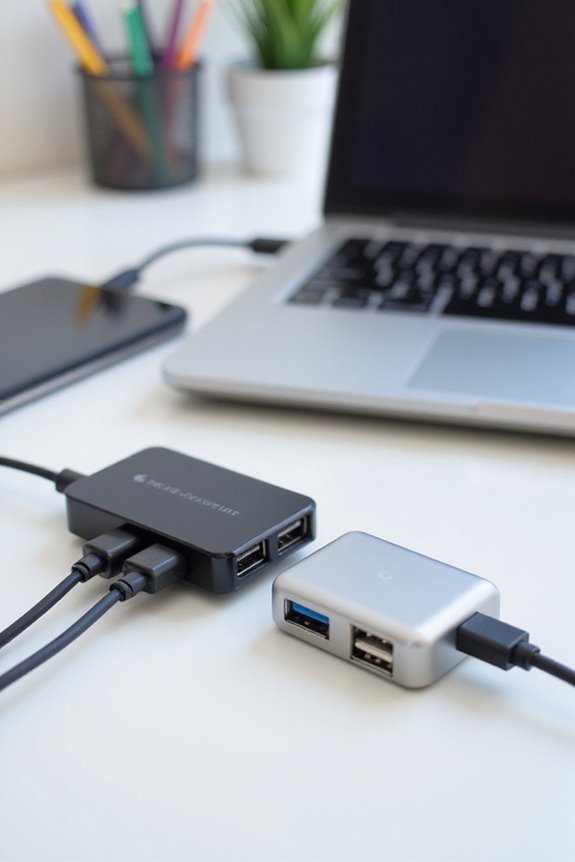
USB-C hubs represent a significant advancement in connectivity options, offering features that go beyond the capabilities of traditional USB-A hubs. With USB C specifications, these hubs support various types, including simple data transfer and multiport hubs that enable video output and power delivery.
Some notable USB C advantages include the ability to charge devices while transferring data, supporting dual 4K displays, and utilizing a reversible connector for easier use. Many hubs also provide multiple connectivity options like USB-A, HDMI, and Ethernet, enhancing versatility.
When choosing a USB-C hub, consider your device’s compatibility, power requirements, and the types of connections needed. Investing in a USB-C hub can future-proof your setup, ensuring it meets evolving technological demands.
Recommended Products

6 in 1 USB-C Hub: This USB C ethernent hub turns a single USB-C port into 6 ports with a 4K@30Hz HDMI, gigabit ethernet, PD 100W charging and 3x USB-A 3.0.

【6-in-1 USB C Hub】Expand one USB-C port into 6 essential ports—including 4K@60Hz HDMI, Gigabit RJ45 Ethernet (1000Mbps), 100W PD charging, 2× USB-A 3.1 Gen1 (5Gbps), and USB-C 3.1 Gen1 data port (5Gbps). Built for seamless multitasking, this all-in-one USB C to USB adapter lets you charge, transfer data, and connect external displays at the same time.

Flawless 4K Video via HDMI: Enjoy crystal-clear visuals with 4K@60Hz output when using a DP 1.4 laptop, or 4K@30Hz with a DP 1.2 laptop—perfect for high-definition presentations and entertainment. (Note: Only the HDMI port supports video output. The USB-C port is for data transfer only.)
Evaluating Portability and Convenience
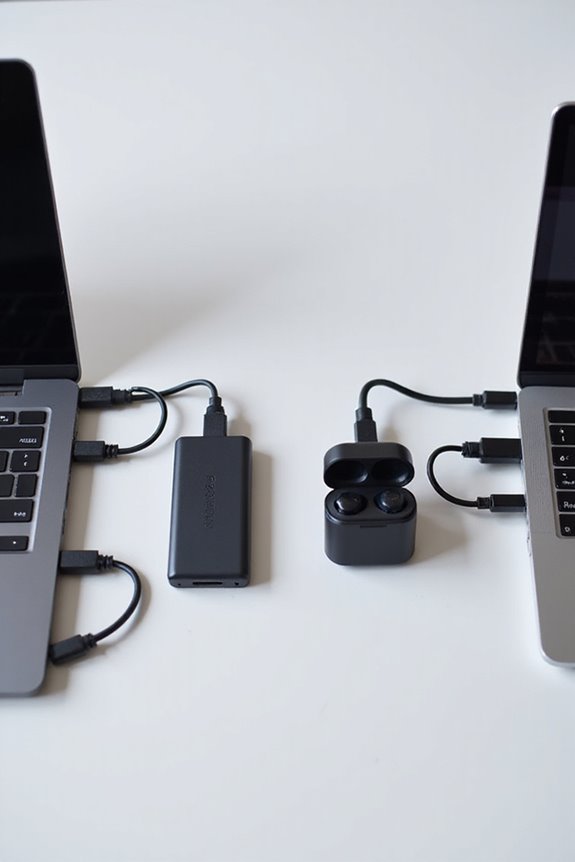
How do USB-A and USB-C hubs stack up regarding portability and convenience? When considering design considerations, USB-C hubs generally shine due to their sleek profiles and lighter weight. These hubs often have shorter or detachable cables, reducing clutter in bags and improving transport convenience. In contrast, USB-A hubs are typically bulkier and can be more challenging to handle due to their non-reversible connectors, which complicates quick access.
From a user experience perspective, USB-C hubs offer instant connectivity, making them easier to use in tight spaces or low light. While USB-A hubs provide broader compatibility with older devices, the need for adapters with USB-C can add bulk. Ultimately, for modern users, USB-C hubs are often the more portable and convenient choice.
Recommended Products

Office Organizers for Desk: Versatile power dock and USB charger mount to the desk surface with an edge mount bracket for a secure hold. it clamps onto the back or side of your desk for a semi-permanent mount that won’t be knocked back into your nest of cables.

5-in-1 Connectivity: Equipped with a 4K HDMI port, a 5 Gbps USB-C data port, two 5 Gbps USB-A ports, and a USB C 100W PD-IN port. Note: The USB C 100W PD-IN port supports only charging and does not support data transfer devices such as headphones or speakers.

Versatile power dock and USB charger mount to the deck surface with an edge mount bracket for a secure hold. it clamps onto the back or side of your desk for a semi-permanent mount that won’t be knocked back into your nest of cables.
Analyzing Cost and Value
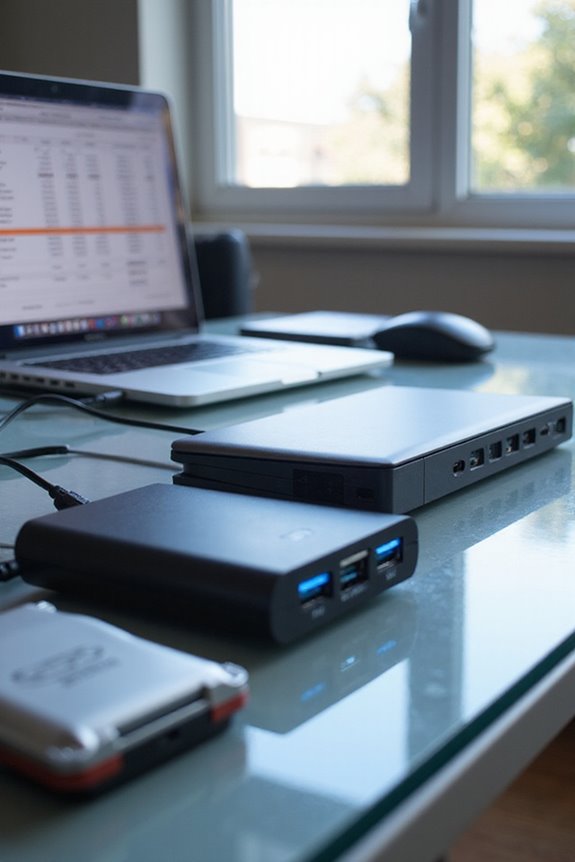
While evaluating the cost and value of USB hubs, it’s essential to take into account various factors that influence their pricing and functionality. USB-C hubs can range from $10 to over $100, with costs driven by features like the number of ports and brand reputation. Regarding cost efficiency, higher-priced models often provide greater versatility, such as power delivery and multiple port types. Budget options exist, typically priced between $15 and $25, but these may lack advanced features. My value assessment suggests that investing in a hub with more capabilities can enhance long-term satisfaction, especially as USB-C becomes the standard. Ultimately, understanding these factors helps guarantee you choose a hub that meets both your needs and budget.
Recommended Products

Ultra-Fast 10Gbps: 5-in-1 USB C Hub with 4 USB-C 3.2 Gen 2 ports, offering 10Gbps high-speed data transfer which can transfer 1GB of files in 1 second. As a USB-C hub for laptops it effortlessly transfers large files, quickly uploads and edits videos, and backs up data with ease.📌📌𝐍𝐎𝐓𝐄: 𝐅𝐨𝐫 𝐟𝐮𝐥𝐥 𝟏𝟎𝐆𝐛𝐩𝐬 𝐬𝐩𝐞𝐞𝐝, 𝐩𝐥𝐞𝐚𝐬𝐞 𝐜𝐨𝐧𝐧𝐞𝐜𝐭 𝐭𝐨 𝐚 𝟏𝟎𝐆𝐛𝐩𝐬-𝐜𝐚𝐩𝐚𝐛𝐥𝐞 𝐩𝐨𝐫𝐭 𝐚𝐧𝐝 𝐮𝐬𝐞 𝐚 𝐡𝐢𝐠𝐡-𝐬𝐩𝐞𝐞𝐝 𝐝𝐞𝐯𝐢𝐜𝐞.

Sleek 7-in-1 USB-C Hub: Features an HDMI port, two USB-A 3.0 ports, and a USB-C data port, each providing 5Gbps transfer speeds. It also includes a USB-C PD input port for charging up to 100W and dual SD and TF card slots, all in a compact design.

5 in 1 Connectivity: The USB C Multiport Adapter is equipped with a 4K HDMI port, a 100W USB C PD port, a 5 Gbps USB A data port, and two 480 Mbps USB A ports
Comparing Data Transfer and Performance

When evaluating data transfer and performance, it’s essential to recognize the significant differences between USB-A and USB-C hubs. USB-A typically supports older standards, with speeds up to 480 Mbps, primarily using USB 2.0. In contrast, USB-C can handle much faster protocols, reaching up to 40 Gbps with USB 4. This means that for high-speed tasks, USB-C outperforms USB-A due to its efficient data transfer capabilities. Performance metrics also reveal that USB-C supports dynamic bandwidth allocation, optimizing data transfer and video simultaneously. In real-world scenarios, USB 3.1 Gen2 excels at loading large files faster than its predecessor. As a result, if data transfer and performance are your priority, USB-C is the clear choice.
Recommended Products
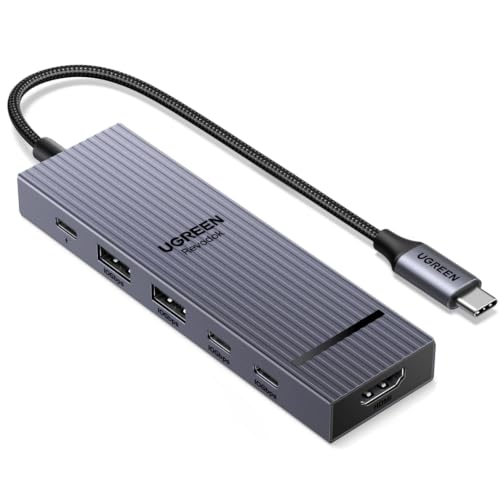
6-in-1 10Gbps USB C Hub: Inspire more potential of your laptop’s USB-C port with two 10 Gbps USB-C 3.2 Gen 2 port, two 10 Gbps USB-A 3.2 Gen 2 ports, 4K 60Hz HDMI and 100W Power Delivery. Ultimate all-in-one dock, works on multiple ports simultaneously

Hybrid USB Port Expander: Rosonway 7 Ports Powered USB hub with 4 USB-C 3.2 ports and 3 USB-A 3.2 ports, allowing you to easily connect to your laptop, desktop, gaming console, and more—transforming a single port into a complete workstation. Plug-and-play, no drivers required. Simplify your setup and boost productivity

Hybrid USB C Hub: This usb hub features 1*USB-C 3.2 10Gbps + 2 USB A 3.2 10Gbps, 4 USB-A 3.0 5Gbps and 2 USB-C PD 45W Fast Charging Ports(Not support data transmission) , use the usb hub for pc to extend your laptop, desktop, gaming host and more. Note: Powered usb hub do not support video output function.⚠️Note: The usb hub powered is not recommended for charging computers or other high-power devices.
Assessing Compatibility and Versatility
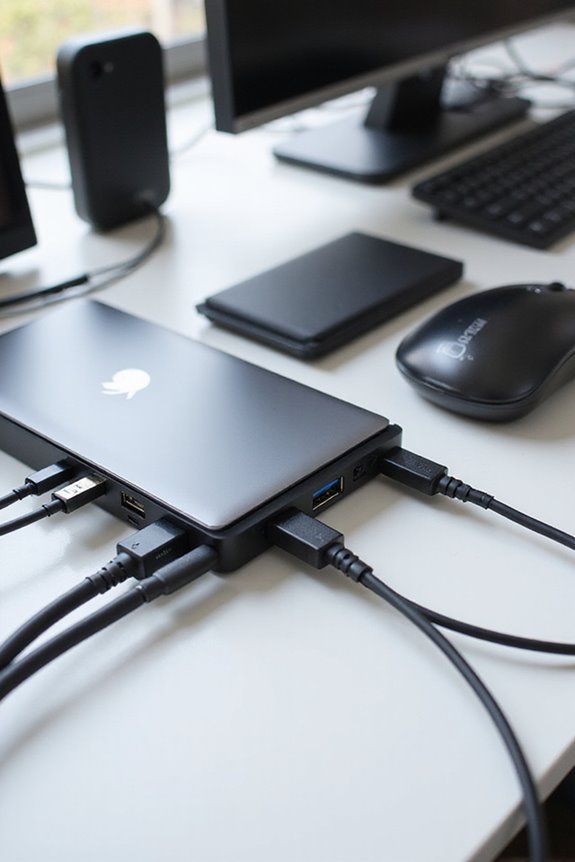
Understanding the compatibility and versatility of USB hubs is essential for making an informed decision. When I consider USB-A hubs, I appreciate their legacy device compatibility, often connecting older peripherals like keyboards and mice. However, they lack the power delivery and protocol support seen in USB-C hubs. USB-C’s versatility is evident in its ability to support multiple protocols, including USB, DisplayPort, and HDMI, making it suitable for modern devices. The reversible design and ability to deliver up to 240W also enhance its practicality, especially for high-power devices. As technology advances, opting for USB-C guarantees compatibility with the latest devices and peripherals, future-proofing my setup for various applications and user needs.
Frequently Asked Questions
Can I Use a USB-C Hub With a USB-A Device?
Using a USB-C hub with a USB-A device is like finding treasure in your attic. Just watch for compatibility issues and performance differences; they can affect your experience. But it’s totally doable!
What Is the Lifespan of USB-A vs. USB-C Hubs?
When I consider the durability comparison between USB-A and USB-C hubs, I notice USB-C generally lasts longer due to technology evolution, supporting more insertions and featuring advanced protocols that guarantee better performance over time.
Do USB-C Hubs Support Ethernet Connections?
They say, “A bird in the hand is worth two in the bush.” Yes, USB-C hubs do support Ethernet connections, enhancing hub performance with excellent Ethernet compatibility, which I find invaluable for stable, fast internet access.
How Do I Troubleshoot a Malfunctioning Hub?
When troubleshooting a malfunctioning hub, I check connections first. If connection issues persist, I inspect for damage, update drivers, and test different ports to guarantee ideal hub performance. It’s often a simple fix!
Are There Any Brands That Specialize in USB Hubs?
When I look for USB hubs, I prioritize brand reliability and hub performance. Anker and Sabrent are favorites of mine, known for their quality and versatility, ensuring I get the best connectivity for my devices.
{
“@context”: “https://schema.org”,
“@type”: “FAQPage”,
“mainEntity”: [
{
“@type”: “Question”,
“name”: “Can I Use a USB-C Hub With a USB-A Device?”,
“acceptedAnswer”: {
“@type”: “Answer”,
“text”: “Using a USB-C hub with a USB-A device is like finding treasure in your attic. Just watch for compatibility issues and performance differences; they can affect your experience. But it’s totally doable!”
}
},
{
“@type”: “Question”,
“name”: “What Is the Lifespan of USB-A vs. USB-C Hubs?”,
“acceptedAnswer”: {
“@type”: “Answer”,
“text”: “When I consider the durability comparison between USB-A and USB-C hubs, I notice USB-C generally lasts longer due to technology evolution, supporting more insertions and featuring advanced protocols that guarantee better performance over time.”
}
},
{
“@type”: “Question”,
“name”: “Do USB-C Hubs Support Ethernet Connections?”,
“acceptedAnswer”: {
“@type”: “Answer”,
“text”: “They say, “A bird in the hand is worth two in the bush.” Yes, USB-C hubs do support Ethernet connections, enhancing hub performance with excellent Ethernet compatibility, which I find invaluable for stable, fast internet access.”
}
},
{
“@type”: “Question”,
“name”: “How Do I Troubleshoot a Malfunctioning Hub?”,
“acceptedAnswer”: {
“@type”: “Answer”,
“text”: “When troubleshooting a malfunctioning hub, I check connections first. If connection issues persist, I inspect for damage, update drivers, and test different ports to guarantee ideal hub performance. It’s often a simple fix!”
}
},
{
“@type”: “Question”,
“name”: “Are There Any Brands That Specialize in USB Hubs?”,
“acceptedAnswer”: {
“@type”: “Answer”,
“text”: “When I look for USB hubs, I prioritize brand reliability and hub performance. Anker and Sabrent are favorites of mine, known for their quality and versatility, ensuring I get the best connectivity for my devices.”
}
}
]
}